Real-world analysis finds gray-market retatrutide underperforms and raises cardiovascular symptoms
A preprint analysis of US medical records found people using non-trial retatrutide lost 7.2% of body weight versus 15.5% in trial patients, while still showing faster heart rates.

Researchers at the health data company nference report that use of gray-market retatrutide — an unapproved Eli Lilly drug being sold online — grew 1.8-fold per quarter between October 2023 and March 2026, and that people taking non-trial versions lost less than half the weight seen in clinical trial participants while still showing a measurable rise in heart rate [1][2]. The findings were posted as a preprint, meaning they have not completed peer review [1].
Retatrutide is an injectable that activates three receptors at once: GIP, GLP-1 and glucagon [2]. Approved drugs like semaglutide (Ozempic, Wegovy, Rybelsus) and tirzepatide (Mounjaro, Zepbound) hit one or two of those targets [2]. Retatrutide is still in phase 3 testing, and Lilly says it plans to file for FDA approval in the first quarter of 2027 [1][2].
What the researchers did
Because retatrutide has no National Drug Code, no pharmacy claim and no structured prescription record, the team used large language models to search de-identified clinical notes from US academic medical centers and health systems [1]. They found 983 patients whose notes mentioned the drug, confirmed actual exposure in 652 (66.3%), and traced a supply route in 531 (54%) [1]. Of those 531, 378 (71.2%) got the product outside a clinical trial — 217 (57.4%) through online or telehealth vendors, 111 (29.4%) through compounding pharmacies, and 33 (8.7%) through wellness clinics or medical spas [1][2]. New users grew 1.8-fold per quarter, reaching 228 in the first quarter of 2026 [2].
A clinician re-reviewed 320 randomly sampled extractions; exposure classification was 99.8% accurate and supply route about 90% accurate [1][2].
The weight and heart-rate numbers
The team built four matched groups: 89 retatrutide trial participants, 243 direct-to-consumer users, 890 semaglutide starters and 890 tirzepatide starters, balanced on age (about 51), sex (about 63% women), BMI (about 33) and prior incretin use (about 37.1%) [1].
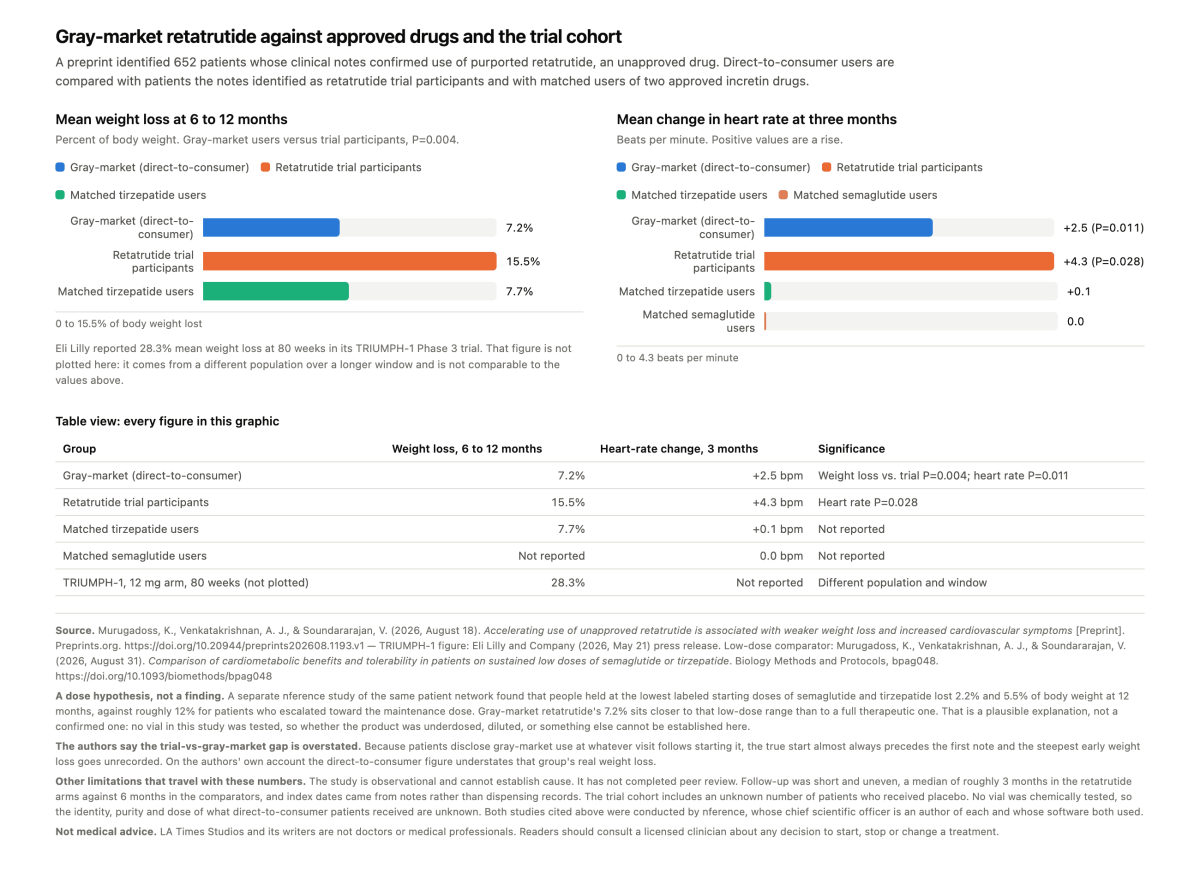
At 6 to 12 months, trial participants lost 15.5% of body weight [1]. Direct-to-consumer users lost 7.2% (P=0.004) — roughly the same as matched tirzepatide users at 7.7% [1][2]. For context, Lilly reported 28.3% average weight loss at 80 weeks in the 12 mg arm of TRIUMPH-1, with 45.3% of patients losing at least 30% [2].
Heart rate rose at 3 months in both retatrutide groups — up 4.3 beats per minute in the trial cohort and 2.5 bpm in the gray-market cohort — a change not seen in the semaglutide or tirzepatide groups [1]. Pooling both retatrutide groups, new-onset tachycardia was 2.88 times more frequent than in matched tirzepatide users (95% CI 1.68-4.85; P<0.001) [2]. The pooled retatrutide cohort also had significantly higher new-onset cardiovascular symptoms (relative risk 1.56) and neuropsychiatric symptoms (RR 1.95) than the comparators [1]. Rates of major adverse cardiac events were numerically higher than tirzepatide (RR 1.77) but were not statistically significant [1].
The authors listed real limits: the study is observational and cannot prove cause, follow-up was short and uneven (median about 3 months in the retatrutide arms versus 6 months for comparators), and start dates came from notes rather than dispensing records [1]. The authors are nference employees, though they said no company funded or shaped the work [1].
Why it matters for patients
The core finding is a gap between what is advertised and what showed up in charts. Products sold as retatrutide did not deliver trial-level weight loss, yet the cardiovascular signal — a faster heart rate — was still present [1]. Purity, dose and manufacturing quality in these channels cannot be verified, said Priya Jaisinghani, MD, an obesity specialist at NYU Langone Health who was not involved in the study [1].
Some notes documented products mixed with other unapproved peptides, including cagrilintide, BPC-157, NAD+ and IGF-1 analogues, none of which have been tested in clinical trials [1].
There is also a visibility problem: none of this use appears in prescription or insurance records, so clinicians learn about it only when patients mention it [2]. Both Soundararajan and Jaisinghani said doctors should ask patients directly about unapproved peptide use [1].
What happens next
The FDA told state pharmacy boards in a March 31, 2025 letter that retatrutide has no USP monograph and is not on the 503A or 503B bulk substances lists, so compounded versions qualify for neither exemption [2]. The agency issued a warning letter to Summit Research Peptides on December 10, 2024 [2]. Lilly has filed multiple lawsuits against sellers and opened an expanded access program for certain patients with severe, refractory obesity [1]. An FDA filing is expected in the first quarter of 2027; an approval date is not yet known [1][2].
Images from the sources
Sources
Semaglutides.org is for information only and is not medical advice. Always talk to a licensed healthcare provider about your own care. Some links to telehealth services are affiliate links, labeled where they appear.