Citi raises its Lilly price target to $1,600 after a month of share weakness
Citi raised its price target on Eli Lilly to $1,600 after the stock fell 16% in a month, betting that tirzepatide's obesity-drug lead and new pipeline drugs will outweigh recent price cuts.
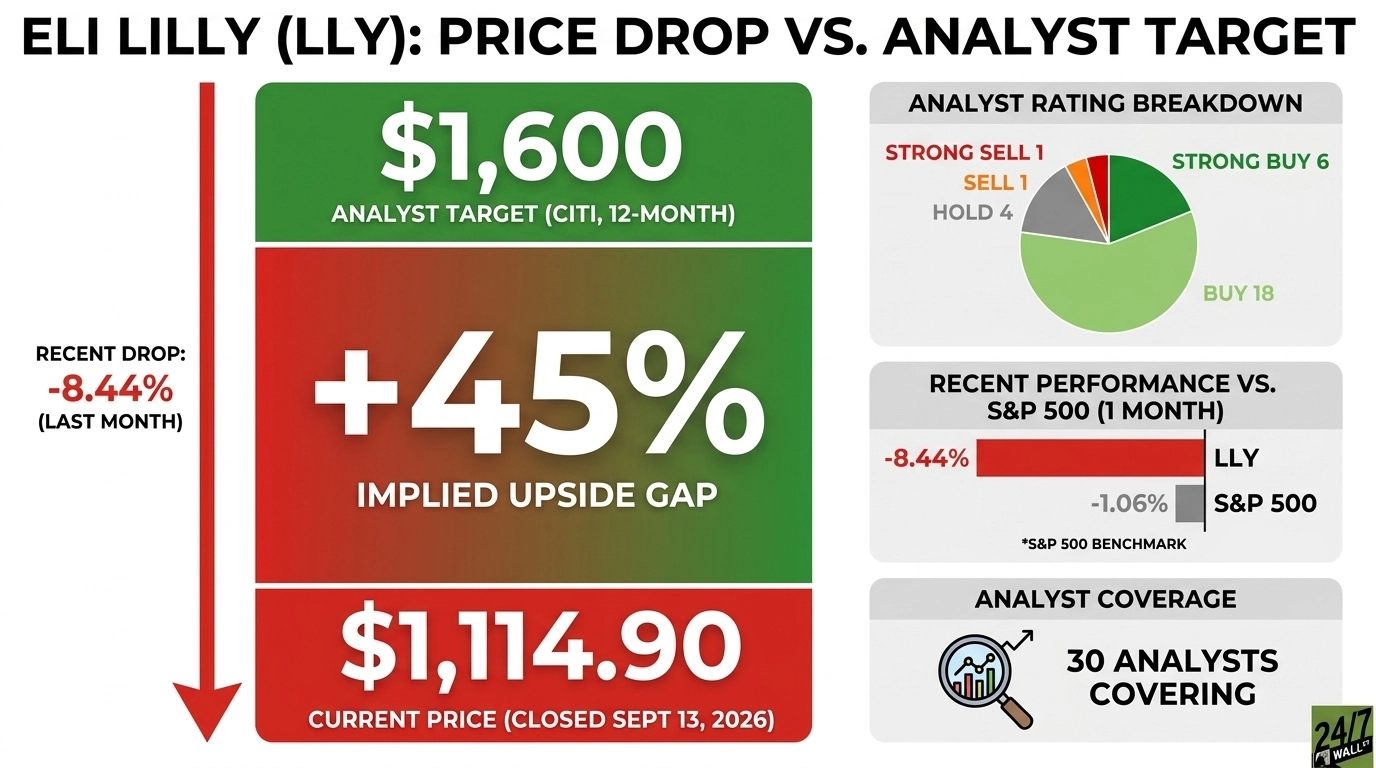
An analyst at Citi raised his 12-month price target on Eli Lilly to $1,600 from $1,500 on September 14, 2026, keeping a Buy rating even after the company's shares fell roughly 16% over the prior month [1][2]. The call is a bet that Lilly's obesity and diabetes drugs, tirzepatide (sold as Mounjaro and Zepbound) and the newer orforglipron (Foundayo), can keep growing fast enough to outweigh recent price cuts that had rattled investors [1].
The stock drop came alongside real numbers, not just sentiment. Lilly's realized U.S. prices fell about 9% when rebate adjustments are excluded, which some on Wall Street read as the start of a broader pricing fight among GLP-1 makers [1]. Lilly also booked $2.78 billion in charges tied to recent biotech acquisitions, including Orna, Kelonia, Ajax and Centessa, which complicated its reported earnings [1]. Even so, second-quarter revenue grew 48% to 49.6% year over year depending on the source, and Lilly raised its full-year 2026 revenue guidance to $85 billion to $87 billion [1][2].
Citi's bullish case rests on tirzepatide's market position: the drug still accounts for roughly six of every ten U.S. obesity prescriptions and about seven of every ten injectable prescriptions [1]. Foundayo, the once-daily oral GLP-1 pill, expanded from about 8,000 prescribers to 36,000 in a single quarter, with a global rollout planned for 2027 [1]. Lilly is also preparing to file for approval of retatrutide, a triple-hormone drug, in the first quarter of 2027, after trial data showed participants lost an average of 70.3 pounds, or 28.3% of body weight, over 80 weeks at the highest dose tested [2]. One research firm, Clarivate, projects retatrutide could reach $30 billion in annual sales by 2031 and Foundayo could reach $16 billion [2].
Not everyone reads Lilly's position the same way. Novo Nordisk, Lilly's main rival in this drug class, trades at a far lower valuation multiple and has seen weaker revenue growth and falling free cash flow this year [2]. Analysts covering Lilly are split too: of 30 firms tracked, 6 rate it Strong Buy, 18 Buy, 4 Hold, 1 Sell and 1 Strong Sell, and the average 12-month target across all of them, at $1,318.66, implies far less upside than Citi's number [1].
Why it matters for patients
This is a story about stock prices, not about drug safety or effectiveness, but it touches patients indirectly through pricing. The reported 9% drop in Lilly's realized U.S. prices, before rebates, suggests some downward pressure on what insurers and pharmacy benefit managers are actually paying for tirzepatide products, though it is not clear from these sources how much of that reaches patients directly at the pharmacy counter [1]. Whether that trend continues, reverses, or triggers broader price competition among GLP-1 makers is not yet known.
Patients considering or currently using Mounjaro, Zepbound, or the oral drug Foundayo may also want to note that manufacturing capacity remains a live issue. Lilly has spent heavily on new manufacturing, partly funded by debt now totaling $108.4 billion, to keep up with demand for its current drugs and to prepare for retatrutide and expanded Foundayo production [2]. If that capacity buildout falls behind demand, supply could tighten; if it succeeds, availability could improve.
What happens next
Lilly plans to file a Biologics License Application for retatrutide with regulators in the first quarter of 2027, with a possible 2028 launch if approved [2]. Foundayo's international rollout is expected to expand through 2027 [1]. Investors and analysts will also be watching Lilly's coming quarterly earnings reports for further signs of whether U.S. pricing pressure on tirzepatide continues or stabilizes [1].
Sources
Semaglutides.org is for information only and is not medical advice. Always talk to a licensed healthcare provider about your own care. Some links to telehealth services are affiliate links, labeled where they appear.