Eli Lilly closes at $1,115.70 as market value holds near $1 trillion
Lilly's slowing stock momentum reflects falling realized prices even as sales volumes jump, a mix that shapes what patients and insurers may pay for GLP-1 drugs.
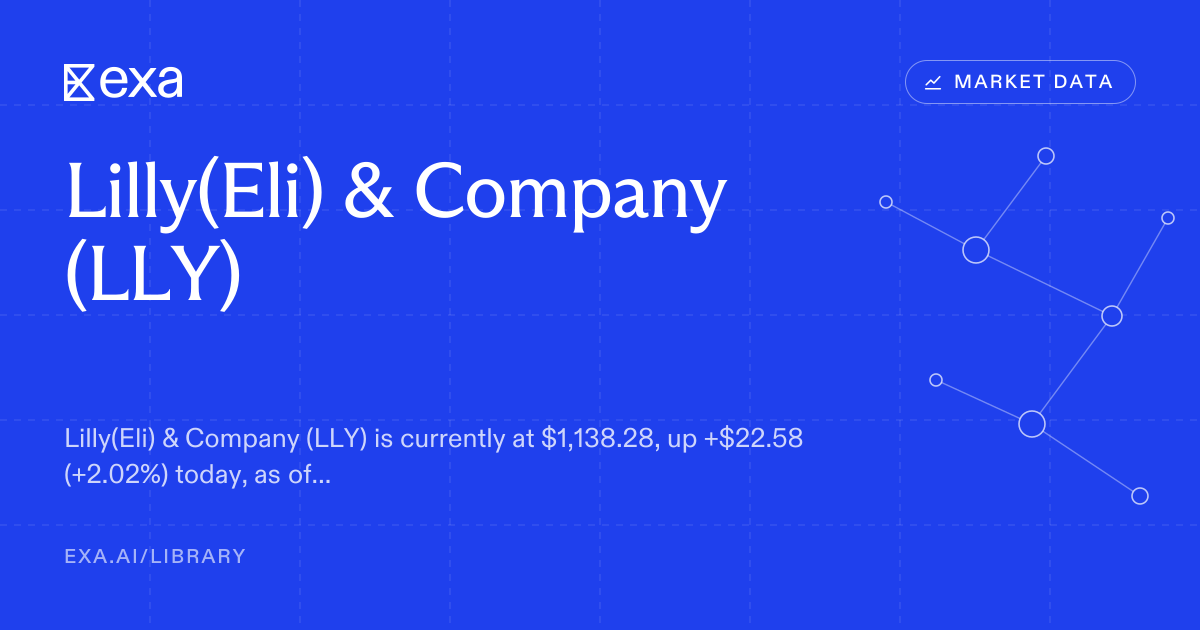
Eli Lilly stock closed at $1,115.70 on September 11, 2026, putting the maker of Mounjaro, Zepbound and Foundayo at a market value of roughly $1 trillion [1][2][3]. The shares traded at $1,138.28 by September 14, up 2.02% from that previous close, according to market data [1].
The numbers behind the trillion-dollar valuation
The twelve-month returns depend on how they are measured. 24/7 Wall St. reported shares up 50.72% over the past year, and down 8.61% over the past month, at a price of $1,123.98 [2]. The Motley Fool's return table lists a one-year return of 48.46% for the period ending September 11, 2026, and a one-month decline of 8.44% [3]. Both place the 52-week high at $1,292.65, which puts the stock roughly 9% below that peak; 24/7 Wall St. lists the 52-week low at $707.59 [2], while the Motley Fool lists it at $712.05 [3].
The market-cap figures also differ slightly by source. 24/7 Wall St. cited a market cap of $1.002 trillion [2]; the Motley Fool lists $1.05 trillion, noting that its figure counts only publicly traded shares outstanding [3].
The underlying business grew in the second quarter of 2026. Revenue reached $22.974 billion, up 47.67% year over year, with earnings per share of $8.38 beating consensus by 27.27%, according to 24/7 Wall St. [2]. The Motley Fool puts quarterly revenue at $23.0 billion, up 48%, and says incretin medicines such as Mounjaro and Zepbound accounted for 65% of revenue for the six months ended June 30, 2026 [3]. Mounjaro alone posted $9.94 billion in the quarter, up 91% [2], and management raised full-year revenue guidance to $85 billion to $87 billion [2].
The pressure point is pricing. Realized prices fell 13% in the second quarter, which 24/7 Wall St. said was more than offset by 60% volume growth [2]. The same article notes the incretin franchise generated about $14.87 billion of the quarter's revenue and cites $2.78 billion in acquired in-process research and development charges [2]. Lilly invested $13.3 billion in 2026 on acquisitions including Orna and Ajax, and paid $2.0 billion in July 2026 for companies building an infectious disease portfolio, according to the Motley Fool [3].
Why it matters for patients
Realized prices are the amounts a drugmaker actually collects after discounts and rebates, so a 13% decline is one signal of how aggressively Lilly is pricing its GLP-1 medicines to hold or win insurance coverage [2]. Those same negotiations shape what patients pay at the pharmacy counter.
Access is also widening. 24/7 Wall St. reports Foundayo, described as the first oral GLP-1 with no food or water restrictions, expanded to 36,000 prescribers, and states that the Medicare GLP-1 Bridge Program opened access for 20 million eligible Americans at $50 per month [2]. An oral option that does not require timing around meals gives patients a choice that does not involve an injection.
At the same time, Lilly's revenue is concentrated. Incretin medicines made up 65% of revenue for the first six months of 2026 [3], and roughly $14.87 billion of second-quarter revenue came from that franchise [2]. That concentration is why pricing trends and launch execution move both the stock and the company's willingness to keep expanding access programs.
What happens next
Lilly's next estimated earnings date is October 29, 2026 [3]. A submission for retatrutide, the company's triple-agonist candidate, is planned for the first quarter of 2027 [2]. Whether realized-price declines continue at the second-quarter pace has not been disclosed [2]. The company has not said whether it will adjust list prices or access programs in response to the pricing trend.
Images from the sources
Sources
Semaglutides.org provides information only, not medical advice. Talk to a licensed provider about your own care before making changes. Some telehealth links are affiliate links and are labeled where they appear.