Lilly's EloraTZP combination of eloralintide and tirzepatide beats tirzepatide 15 mg in Phase 2b
Eli Lilly says adding its experimental amylin drug eloralintide to tirzepatide led to an average 54.1 lbs (23.3%) of weight loss in a 48-week mid-stage trial, with more dropouts from side effects.
Eli Lilly reported on September 30, 2026 that EloraTZP — an investigational combination of its amylin receptor agonist eloralintide plus tirzepatide — produced more weight loss and bigger blood sugar drops than tirzepatide 15 mg alone in a 48-week Phase 2b trial of 367 adults with obesity or overweight and type 2 diabetes [1]. The results were presented at the 62nd Annual Meeting of the European Association for the Study of Diabetes in Milan, Italy [1].
At the highest combination dose (eloralintide 9 mg plus tirzepatide 15 mg), participants lost an average of 23.3% of their body weight, or 54.1 lbs, from an average starting weight of 232.4 lbs (105.4 kg) [1]. Tirzepatide 15 mg alone produced 14.8% (34.4 lbs), eloralintide alone produced up to 12.3% (28.6 lbs) at the 6 mg dose, and placebo produced 3.0% (7.0 lbs) [1]. Other combination arms landed in between: 13.2% with eloralintide 3 mg plus tirzepatide 5 mg, 19.4% with eloralintide 6 mg plus tirzepatide 5 mg, and 19.9% with eloralintide 6 mg plus tirzepatide 10 mg [1].
On blood sugar, A1C fell by up to 2.9% with the combination versus 2.4% with tirzepatide 15 mg, up to 1.4% with eloralintide alone and 0.3% with placebo, from an average baseline A1C of 8.1% [1]. These figures come from what Lilly calls the efficacy estimand, which represents results as if all randomized participants had stayed on treatment for the full 48 weeks [1].
Tolerability is the open question
The most common side effects were gastrointestinal, generally mild or moderate, and happened mostly while doses were being raised [1]. They occurred more often in the combination groups than with either drug alone [1]. Discontinuations due to side effects ranged from 10.8% to 27.0% in the EloraTZP arms, compared with 2.9% for tirzepatide alone, 0% to 10.8% for eloralintide alone and 16.7% for placebo [1].
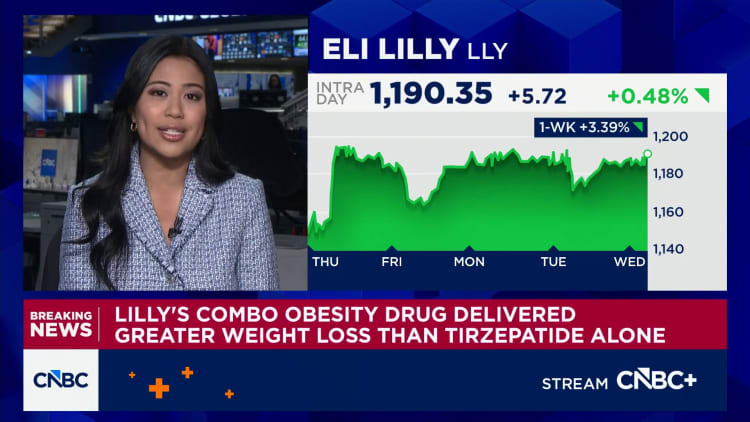
Ken Custer, president of Lilly Cardiometabolic Health, told CNBC that the highest dose of tirzepatide showed similar elevated dropout rates of around 25% in a mid-stage trial back in 2018, and said discontinuation in Phase 2 is "probably not the best indicator of the tolerability of a medicine" [3]. Lilly says it plans to adjust the dosing schedule in Phase 3 [3].
The trial randomized participants in the U.S. and Argentina across 10 arms [1]. In this study, eloralintide and tirzepatide were given as two separate injections [1]. Doses were escalated every four weeks; tirzepatide arms started at 2.5 mg and eloralintide arms started at 1 mg or 3 mg [1].
Why it matters for patients
Adults who have both obesity and type 2 diabetes typically lose less weight on GLP-1 and GIP/GLP-1 drugs than people without diabetes, and this trial tested whether adding a third hormone pathway closes that gap [3]. The data suggest it can, at least on average and at the highest doses studied.
But nothing here changes what is available at the pharmacy today. EloraTZP is investigational and has not been reviewed or approved by the FDA. Eloralintide is a once-weekly drug previously known as LY3841136 and is already in Phase 3 testing as a standalone obesity treatment [1]. Tirzepatide is the active ingredient in Zepbound and Mounjaro, both already approved [1].
The side effect profile matters as much as the weight numbers. Up to about one in four people on the combination stopped treatment because of adverse events in this trial [1]. Whether a revised dose escalation schedule brings that down is not yet known. Price, insurance coverage and how the combination would be dosed in practice have not been disclosed.
Lilly also plans a co-formulation so that both drugs can be given in a single injection rather than two [3].
What happens next
Lilly said it will begin Phase 3 trials of EloraTZP in the fourth quarter of 2026, advancing a co-formulated product by the end of the year using an optimized escalation schedule [1]. Phase 3 trials of eloralintide alone for obesity, with and without type 2 diabetes, are already underway [1]. Lilly has not announced when Phase 3 results or any regulatory filing for the combination might arrive.
Images from the sources

Sources
- https://investor.lilly.com/news-releases/news-release-details/lillys-eloratzp-combination-eloralintide-and-tirzepatide
- https://www.biospace.com/press-releases/lillys-eloratzp-combination-of-eloralintide-and-tirzepatide-delivered-greater-weight-loss-and-a1c-reduction-vs-tirzepatide-15-mg-in-adults-with-obesity-and-type-2-diabetes
- https://www.cnbc.com/2026/09/30/eli-lilly-obesity-drug-amylin-tirzepatide-weight-loss-trial.html
- https://www.bloomberg.com/news/articles/2026-09-30/lilly-drug-combo-spurs-record-weight-loss-in-diabetes-study
Semaglutides.org is for information only and is not medical advice. Always talk to a licensed healthcare provider about your own care. Some links to telehealth services are affiliate links, labeled where they appear.