CEO Jorgensen testifies before the Senate HELP Committee on Ozempic and Wegovy prices
Novo Nordisk's CEO faced Senate questioning over US list prices of $969 a month for Ozempic and $1,349 for Wegovy, and did not commit to cutting them.
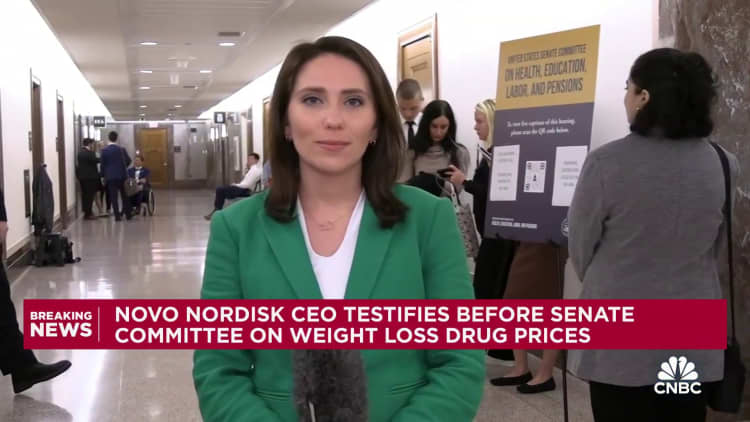
Novo Nordisk CEO Lars Fruergaard Jørgensen testified before the Senate Health, Education, Labor and Pensions Committee on September 24, 2024, where Chairman Bernie Sanders (I-Vt.) pressed him on why Americans pay far more for semaglutide than patients in other wealthy countries [1][2]. Jørgensen did not promise to lower prices, but said he wants to work with lawmakers on "structural issues" driving up US drug costs [2].
The price gap at the center of the hearing
Sanders said Ozempic, the diabetes version of semaglutide, carries a US list price of $969 a month, compared with $155 in Canada, $122 in Denmark, $71 in France and $59 in Germany [1]. Wegovy, the obesity version, lists at $1,349 a month in the US, versus $265 in Canada, $186 in Denmark, $137 in Germany and $92 in the United Kingdom [1]. CNBC reported the same US figures, citing Novo Nordisk's own list-price pages [2].
List price is not what everyone pays. Sanders acknowledged that pharmacy benefit managers (PBMs) negotiate rebates, and estimated the net price of Ozempic at nearly $600 a month and Wegovy at more than $800 [1]. He argued the list price still matters for people who are uninsured, who have a large deductible, or whose plan uses coinsurance — a percentage of the list price [1]. He also said 75% of insured Americans, more than 190 million people, cannot get Wegovy covered through their policies [1].
Sanders said Novo Nordisk has booked nearly $50 billion in Ozempic and Wegovy sales since 2018, with 72% of that revenue from the US [1]. He said the company spent $21 billion on research and development over that period and $44 billion on stock buybacks and dividends [1].
What the company said
Jørgensen's written testimony placed much of the blame on PBMs, which he said "exercise near-total control" over access to medicines, and on the complexity of the US system, saying "no single company alone can solve such vast and complicated policy challenges" [2].
He also warned that cutting list prices can backfire. In written testimony he said Novo Nordisk's insulin Levemir had been available to 90% of US patients through formularies, but coverage fell to 36% after the company cut the list price, and the product was eventually discontinued [2].
Sanders countered that he had received written commitments from all major PBMs — including UnitedHealth's Optum Rx and CVS Caremark — that they would not limit coverage if Novo Nordisk substantially lowered list prices, and that some said they could expand coverage [1][2]. Jørgensen called those letters "new information to me" and said he understands "that perhaps the PBMs have changed their minds" [2]. He committed to meeting with PBMs [2].
Sanders also said generic manufacturers told his office they could profitably sell a generic semaglutide for less than $100 a month [1][2]. No generic version of Ozempic is currently available in the US [2].
Why it matters for patients
Nothing at the hearing changed what anyone pays at the pharmacy counter. Jørgensen made no commitment to reduce list prices [2].
The cost arguments do shape coverage decisions that patients feel directly. Sanders cited North Carolina's Republican treasurer, who said dropping Wegovy coverage for about 20,000 state workers avoided doubling health insurance premiums for teachers, firefighters and police officers, and noted Blue Cross Blue Shield of Michigan announced it would stop covering Wegovy over cost [1]. Many health plans cover GLP-1s for diabetes but not weight loss, and Medicare does not pay for weight-loss treatment unless the drug is approved and prescribed for another condition [2].
The scale of spending is why insurers are cautious: the committee estimated $411 billion a year if half of US adults with obesity used these drugs — $5 billion more than Americans spent on all prescription drugs in 2022 [1][2]. Medicare alone spent $4.6 billion on Ozempic in 2022, according to KFF [2]. Eli Lilly's tirzepatide products, Zepbound and Mounjaro, also cost around $1,000 a month before insurance and rebates [2].
What happens next
Analysts expect Ozempic to be eligible for Medicare drug price negotiation when the next list is selected in 2025, with negotiated prices taking effect in 2027 [2]. Lawmakers asked Novo Nordisk to promise not to sue over that process; Jørgensen did not commit, calling the talks "not a fair negotiation, but actually price-setting" [2]. Whether list prices change is not yet known.
Sources
Semaglutides.org is for information only and is not medical advice. Always talk to a licensed healthcare provider about your own care. Some links to telehealth services are affiliate links, labeled where they appear.