Novo Nordisk announces permanent injunctions against compounders
A federal court left the FDA's end-of-shortage decision for semaglutide in place, and a separate ruling permanently bars one pharmacy from selling compounded "semaglutide" — narrowing legal access to cheaper copies.
Novo Nordisk says courts have handed it two wins that tighten the squeeze on compounded "semaglutide" in the United States: a Texas federal court declined to freeze the FDA's decision that the Wegovy and Ozempic shortage is over, and a separate federal court entered a permanent injunction barring a compounding pharmacy from marketing or selling knockoff semaglutide drugs [1].
According to the company's announcement, a Texas federal court ruled in favor of Novo Nordisk and the FDA, denying a compounding trade association's motion to block the agency's decision to end the shortage of injectable semaglutide medicines [1]. That ruling left in place the FDA's earlier determination that all doses of Wegovy and Ozempic are available nationwide and that Novo Nordisk's supply is meeting or exceeding current and projected patient demand [1]. With the shortage declared resolved, the company says it is illegal under US compounding laws to make or sell knockoff "semaglutide drugs," with rare exceptions [1].
The timing matters for the two different types of compounders. Novo Nordisk says the FDA may immediately take action against 503A pharmacies compounding copies of its FDA-approved semaglutide medicines, while the grace period for 503B outsourcing facilities was set to expire on May 22, 2025, after which the FDA may take enforcement action against them as well [1].
The pharmacy ruling
In the District Court for the Southern District of Texas, a judge entered a final judgment and permanent injunction in Novo Nordisk's favor against MediOak Pharmacy LLC, a 503A pharmacy, permanently prohibiting it from marketing or selling compounded "semaglutide" knockoff drugs [1]. The announcement does not describe any financial terms tied to that specific order.
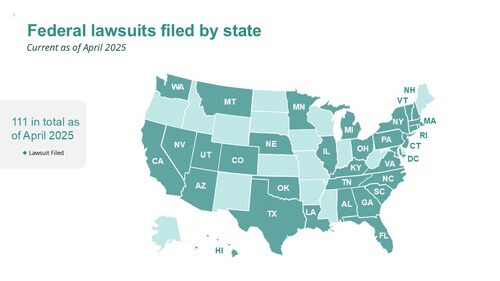
The company says these rulings build on 111 lawsuits it has filed in federal courts across 32 states against entities unlawfully marketing and selling compounded "semaglutide," including products it says posed safety risks because of impurities as high as 33% or inaccurately labeled strengths [1]. Earlier outcomes include an $8.5 million default judgment in Delaware against a business that falsely claimed its compounded product was equivalent to Ozempic or used the same active ingredient; a permanent injunction against Tennessee pharmacy Midtown Express, which Novo Nordisk sued over a product it says contained no semaglutide at all; and a default judgment against an online marketer selling compounded "semaglutide" directly to consumers without a prescription, labeled "Research Use Only" [1].
Many of the court orders also require businesses to post disclosures making clear that compounded drugs have not been reviewed or approved by the FDA and that FDA-approved semaglutide medicines are available [1].
Novo Nordisk also cites a Brookings Institution report, "The Wild East of semaglutide," which it says found that three Chinese firms accounted for 20% of reported semaglutide active ingredient imported into the US between March 2023 and September 2024 and had never been inspected by the FDA as of September 2024, while another three firms responsible for nearly 45% of reported import volume were cited for good manufacturing practice violations at their most recent inspection [1]. The company states it does not distribute the semaglutide active ingredient used in its approved medicines to any entity for compounding [1].
Why it matters for patients
During the shortage, many Americans used compounded semaglutide sold through telehealth companies, med spas and pharmacies, often at lower cash prices. These rulings support the legal basis for ending that pathway for most compounders, which means some sources people were using may stop offering semaglutide or switch to other products [1].
The safety concerns cited are specific: products with high impurity levels, mislabeled strengths, and in at least one case a drug containing no semaglutide [1]. Federal and state officials have raised similar alarms. A bipartisan coalition of 38 state attorneys general urged the FDA to act against compounders, the Ohio attorney general sent warning letters to 14 entities, the Illinois attorney general sent cease-and-desist letters to five Chicago-area med spas in December 2024, and the FBI warned about fraudulent compounding practices tied to weight-loss drugs [1].
One caveat: this account comes from Novo Nordisk's own press release, which presents the company's framing of litigation it brought. Court documents, defendants' responses and any appeals are not included in the source.
What happens next
April 24, 2025: the Texas court denied the motion to freeze the FDA's shortage decision [1]. May 22, 2025: the 503B grace period expires, after which the FDA may take enforcement action against outsourcing facilities compounding semaglutide injectables [1]. Whether individual pharmacies appeal, and how aggressively the FDA enforces, is not yet known from this source.
Sources
Semaglutides.org is for information only and is not medical advice. Always talk to a licensed healthcare provider about your own care. Some links to telehealth services are affiliate links, labeled where they appear.