Novo Nordisk expands its legal campaign against compounded semaglutide sellers
Novo Nordisk says it has filed 132 federal lawsuits in 40 states over compounded "semaglutide," including 14 new cases aimed at telehealth companies and pharmacies.
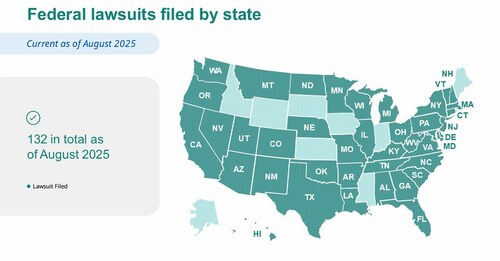
Novo Nordisk announced on August 5, 2025 that it filed 14 new lawsuits against businesses selling compounded products claimed to contain "semaglutide," bringing its running total to 132 complaints in federal courts across 40 states [1]. The Danish drugmaker, which sells semaglutide as Ozempic, Wegovy and Rybelsus, said courts have already issued 44 permanent injunctions against defendants in similar cases [1].
The new filings push Novo's legal campaign into two areas the company says it had not targeted as directly before. The first is pharmacies that produce compounded "semaglutide" under what Novo calls "the fake guise of personalization" in violation of state law [1]. The second is telehealth companies, where Novo alleges corporations rather than doctors steer patients toward compounded products using "sham claims of personalization," which the company says violates California law and state corporate practice of medicine rules [1].
Those rules generally bar non-physician companies from controlling medical decisions. Novo's complaints allege telehealth operators improperly influence prescribers' choices and mislead patients into believing compounded products have been reviewed by the FDA or match the safety and effectiveness of approved semaglutide medicines [1]. It is worth noting these are allegations in a company press release, not proven findings, and the sources here do not include responses from the companies being sued.
The safety claims behind the lawsuits
Novo points to an FDA alert issued July 29, 2025 warning patients and clinicians about compounded GLP-1 drugs, including reports of people overdosing by mistakenly administering five to 20 times the intended dose and needing hospitalization [1]. Dosing errors have been a recurring concern with compounded products, which often come in vials that require a patient to draw up a dose with a syringe rather than in prefilled pens.
The company also cites supply chain data. A Brookings Institution report referenced in the release says many compounded "semaglutide" products rely on synthetic active pharmaceutical ingredient imported from Chinese facilities without FDA oversight or quality controls, and that 60% of Chinese manufacturers shipping "semaglutide" API for compounding or further manufacture are not permitted to distribute that ingredient in China for use in human drugs [1]. Novo adds that, according to FDA data, all "semaglutide" imported into the US for compounding since June 2023 came from suppliers in China [1].
Courts, according to Novo, have barred defendants from compounding "semaglutide" and from falsely claiming the products are FDA-approved, safe, or equivalent to Wegovy or Ozempic, and in some cases have ordered defendants to forfeit profits [1]. The release does not break down which of the 132 cases are still pending, settled, or dismissed, and that detail is not yet known from these sources.
"Patients deserve safe, effective treatments from companies they can trust," said Dave Moore, executive vice president of US operations at Novo Nordisk Inc. "No one should have to gamble with their health by using knockoff drugs made with ingredients that lack oversight and safety standards" [1].
Why it matters for patients
Many people started on compounded semaglutide during the shortage years, often through telehealth platforms and med spas, and often at lower cash prices than branded pens. This litigation is one of the forces reshaping that market. If more sellers are shut down or enjoined, some patients may find their current source disappears with little notice, which can mean an unplanned gap in treatment or a switch to a different product.
The corporate practice of medicine angle is also notable. Novo is not only arguing that the drug itself is unapproved; it is arguing that the business model, in which a company directs which product a prescriber offers, is itself unlawful in some states [1]. If courts agree, that could affect how telehealth weight-loss services are structured, not just which molecule they dispense.
Novo says all doses of Wegovy and Ozempic are available nationwide and that it is exploring new channels to reach patients [1]. The release does not give prices, coverage details, or any comparison of what patients pay for branded versus compounded products, so the cost picture is not addressed in these sources.
What happens next
The 14 new complaints join dozens of pending cases; the release does not list hearing dates or expected rulings [1]. The FDA's July 29, 2025 consumer alert on unapproved GLP-1 drugs remains the agency's most recent public warning cited by Novo [1]. Whether federal or state regulators take separate enforcement action, which Novo explicitly urged, is not yet known [1].
Sources
Semaglutides.org is for information only and is not medical advice. Always talk to a licensed healthcare provider about your own care. Some links to telehealth services are affiliate links, labeled where they appear.