Judge dismisses Eli Lilly's case against Willow Health with prejudice
A federal judge tossed Eli Lilly's false-advertising suit against telehealth compounder Willow Health on February 3, 2026, ruling Lilly failed to show the ads caused lost sales [1].
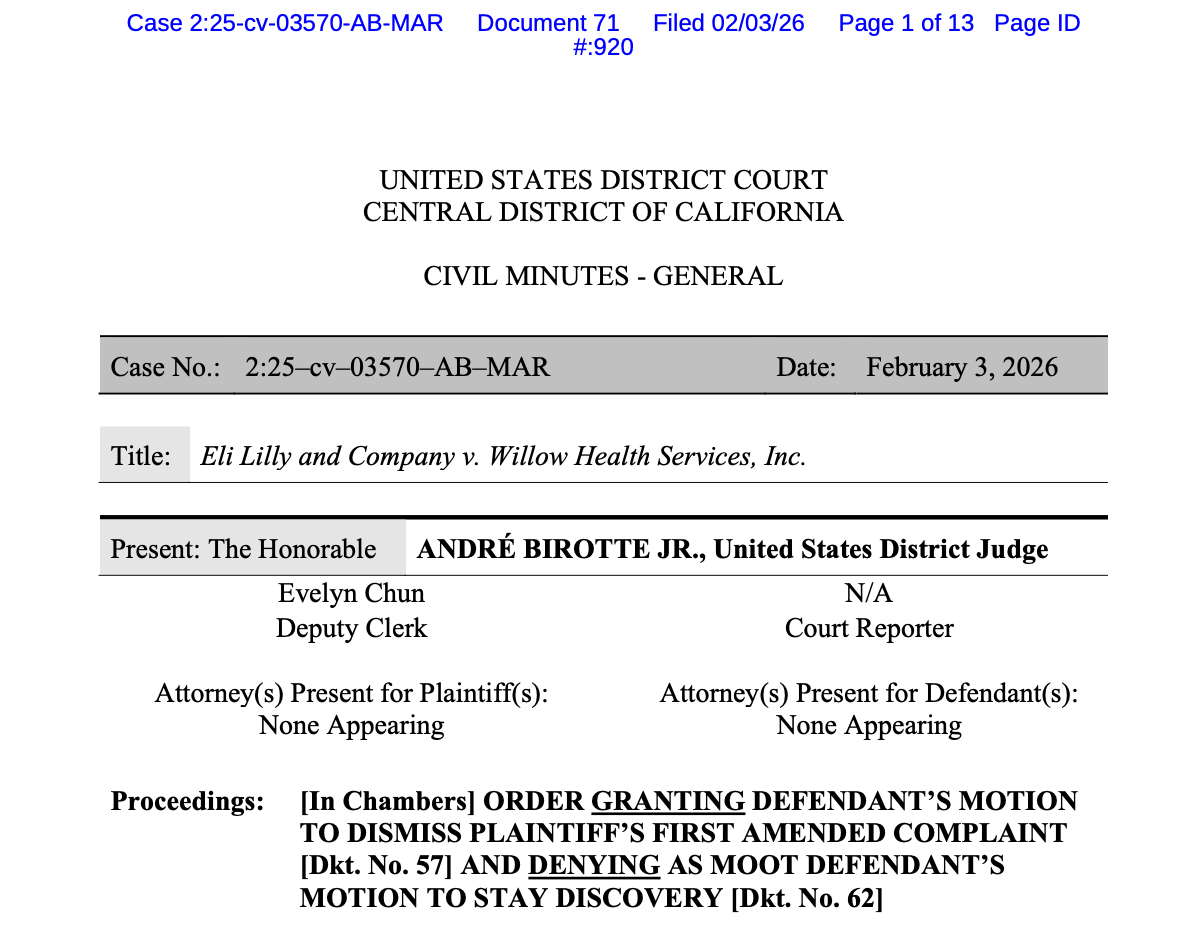
A federal judge in the U.S. District Court for the Central District of California dismissed Eli Lilly's lawsuit against Willow Health Services with prejudice on February 3, 2026, ending the case at the pleading stage [1]. The court granted Willow's motion to dismiss Lilly's false-advertising claims under the Lanham Act and denied Lilly permission to amend its complaint again, meaning the case is over in that court [1].
Lilly's complaint alleged that Willow sold compounded tirzepatide products that are not FDA-approved, marketed them as clinically tested, scientifically validated or superior, implied they were equivalent to Lilly's approved tirzepatide products Mounjaro and Zepbound, and promoted an oral tirzepatide product even though no oral tirzepatide is FDA-approved [1]. Lilly argued that this marketing misled consumers, diverted sales, damaged its reputation and violated the Lanham Act's ban on false and misleading advertising [1]. The suit was a private false-advertising case, not an FDA enforcement action [1].
The ruling turned on causation, not the ads themselves
According to the account of the order, the judge's decision rested on standing and proximate cause rather than on whether Willow's marketing was accurate [1]. The court accepted that Lilly and Willow are direct competitors and that Lilly had plausibly alleged commercial injury at a general level — a point earlier versions of the complaint had not cleared [1].
But Lanham Act standing also requires proximate causation between the advertising and the injury, and that is where the case failed [1]. The court held that Lilly did not plausibly allege that Willow's ads directly caused patients to choose Willow's compounded products over Lilly's drugs, reasoning that prescription drugs are not bought directly by consumers because a physician must prescribe them [1]. That prescribing decision, the court found, breaks the causal chain [1].
The order noted that Lilly's complaint did not identify specific diverted sales, did not connect advertising exposure to prescribing decisions, and did not show a near one-to-one relationship between Willow's ads and Lilly's lost sales [1]. Because Lilly had already amended once, the court concluded further amendment would be futile and dismissed with prejudice [1].
What the court did not decide matters just as much. The judge did not rule that Willow's marketing is accurate, that compounded tirzepatide is safe or effective, that oral tirzepatide works, or that telehealth compounding practices comply with FDA rules [1]. The case failed before the court reached any analysis of whether the ads were false or misleading [1].
Why it matters for patients
For people buying compounded tirzepatide through telehealth platforms, this ruling changes nothing about what is in the vial or whether the claims on a website are true. A procedural dismissal is not a safety or quality finding, and the court said as much by declining to evaluate the advertising at all [1].
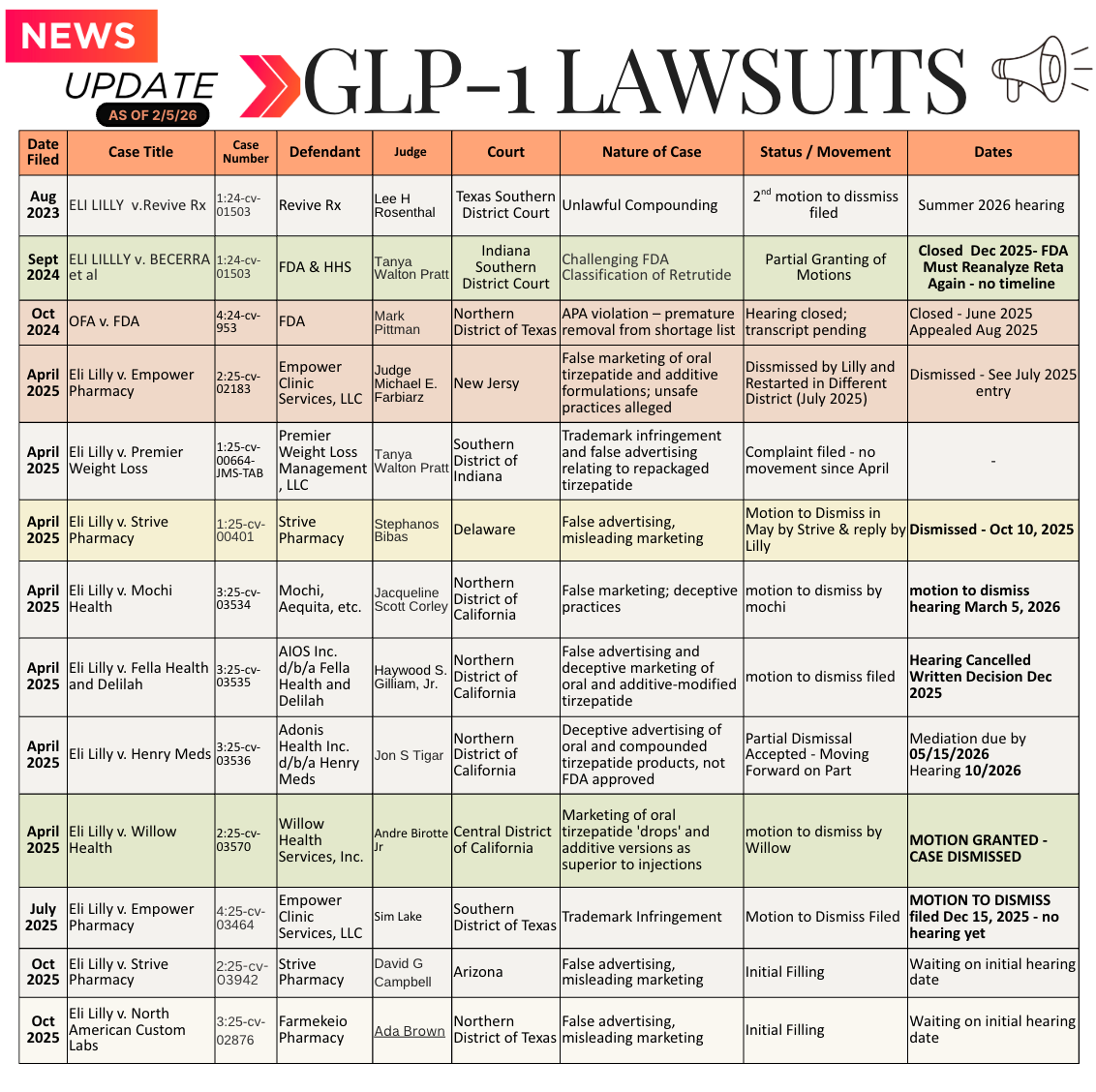
What it may change is the legal pressure on one business model. If manufacturers cannot plausibly link advertising to prescribing to lost sales, Lanham Act claims against telehealth compounders may keep failing — even where the marketing itself is questionable [1]. That could affect other pending Lilly suits against telehealth companies and similar actions by Novo Nordisk or other manufacturers [1].
It is also a narrow win. The ruling does not touch FDA enforcement actions, state pharmacy board actions, consumer protection suits, false claims or insurance litigation, or cases built on manufacturing, safety or misbranding rather than advertising causation [1]. Many GLP-1 compounding cases are moving forward on those other theories, including state unfair-competition laws, consumer deception statutes, and product liability and adverse-event claims [1]. The decision narrows one path, not the whole landscape [1].
One practical takeaway from the court's logic: responsibility for prescription drugs is still gated by a prescriber, even as marketing has become directly consumer-facing through telehealth and social media [1]. Courts are still working out where that leaves advertisers, platforms and manufacturers [1].
What happens next
The order is dated February 3, 2026, in Eli Lilly and Company v. Willow Health Services, Inc., Central District of California [1]. Because the dismissal is with prejudice and leave to amend was denied, the case is finished in that court [1]. Whether Lilly will appeal is not stated in the available source.
The reasoning is likely to show up in motions to dismiss and defense briefs in other GLP-1 compounding cases, where defendants can point to lack of proximate causation, intervening physician judgment and the absence of documented sales diversion [1]. Timelines for those other cases are not covered in this source.
This account is based on a secondary summary of the order rather than the court's own published opinion, so specific quotations from the ruling beyond those described above are not yet confirmed here.
Images from the sources
Sources
Semaglutides.org is for information only and is not medical advice. Always talk to a licensed healthcare provider about your own care. Some links to telehealth services are affiliate links, labeled where they appear.