New York Times profiles MEDVi as a $1.8 billion AI-built startup
A New York Times profile of telehealth seller MEDVi omitted the FDA warning letter the company got six weeks earlier over how it markets compounded semaglutide and tirzepatide.

On April 2, 2026, The New York Times profiled MEDVi, a Los Angeles telehealth startup that sells compounded GLP-1 drugs, as proof of OpenAI CEO Sam Altman's prediction that one person using AI could build a billion-dollar business [1]. The profile described founder Matthew Gallagher's path to a projected $1.8 billion in 2026 sales with two full-time employees — himself and his brother Elliot — plus contract engineers, account managers and outside agencies [1]. It did not mention that the FDA had sent MEDVi a warning letter six weeks earlier [1].
What the FDA said
On February 20, 2026, the FDA warned MEDVi over misbranding the compounded drugs behind that revenue [1]. According to the agency, MEDVi's site falsely suggested the company itself compounded the semaglutide and tirzepatide it sold, and claims such as "Same active ingredient as Wegovy® and Ozempic®" and "Same active ingredient as Mounjaro® and Zepbound®" falsely implied that the products had FDA approval or evaluation [1]. The FDA said failure to fix the violations could lead to seizure or injunction, and added that the letter was "not intended to be an all-inclusive statement of violations that may exist" [1].
In an April 8 statement, MEDVi said the cited website, medvi.io, belonged to an affiliate marketing agency and that MEDVi had "never received a letter from the FDA" [1]. The letter is addressed to "MEDVi, LLC dba MEDVi" in Newark, Delaware, uses a help@medvi.io email address, and cites MEDVi-branded claims on medvi.io [1].
AI doctors in the ads
Critical follow-up reporting focused on how the products are marketed. A Drug Discovery & Development review on April 3 found more than 5,000 active ads in Meta's Ad Library for "medvi," many running under what appeared to be fabricated physician personas, including one page for "Dr. Robert Whitworth" categorized as an "Entertainment website" with a street address that does not appear to exist, plus names like "Professor Albust Dongledore" [1]. A Business Insider investigation identified profiles such as "Dr. Matthew Anderson MD," linked to an Angolan phone number, and others with garbled text or AI watermarks [1]. After Business Insider raised the issues, active MEDVi-related ads fell from more than 5,000 to roughly 2,800 [1].
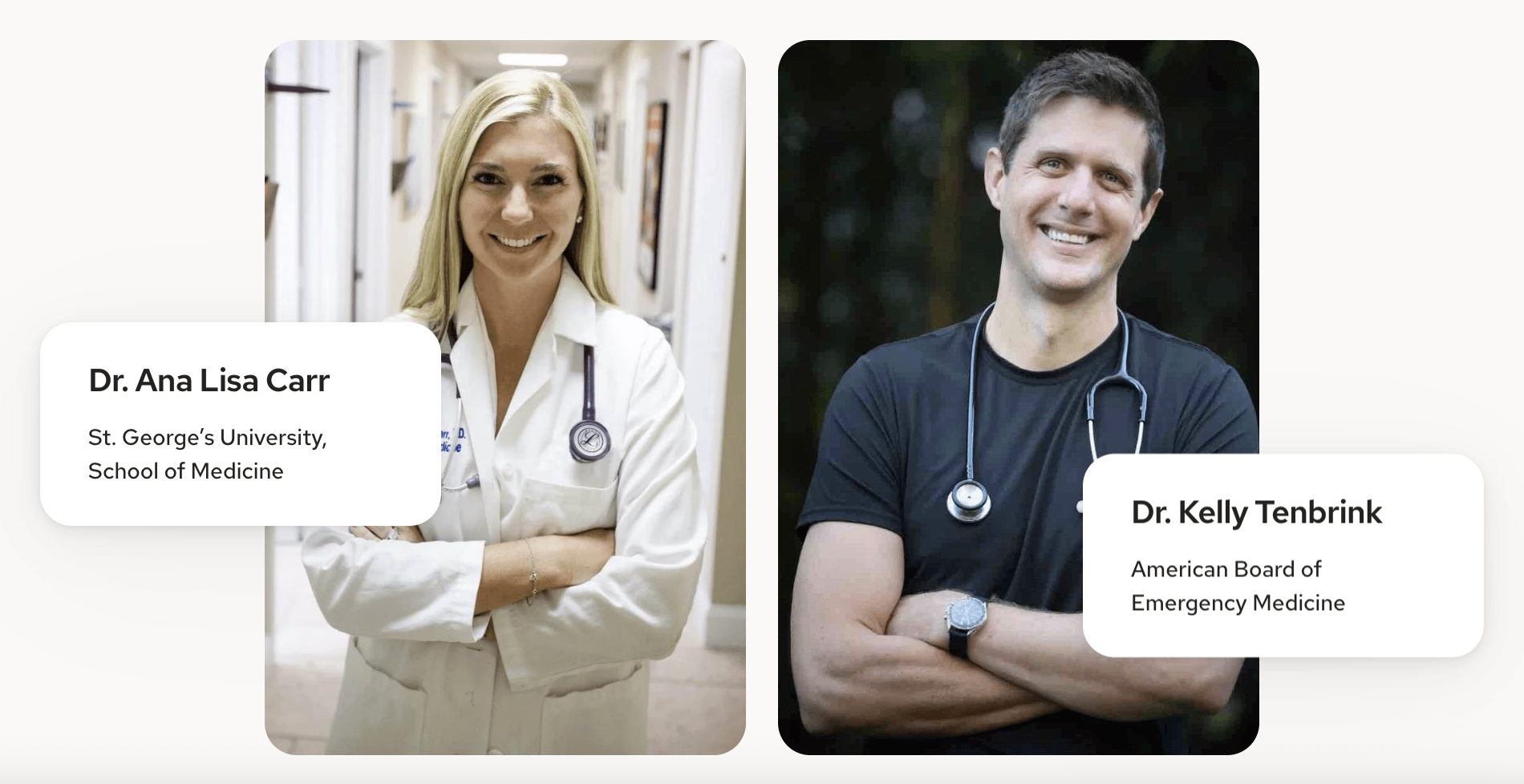
Gallagher told Business Insider that "maybe 30%" of the company's advertising ran through affiliates and that "in line with the FTC, we have a clear policy of providing disclosure on any actor or AI portrayal of a doctor or not using them at all" [1]. MEDVi's site fine print says individuals in ads "may be actors or AI portraying doctors and are not licensed medical professionals" [1]. MEDVi reported 250,000 customers by the end of 2025; its current homepage claims "500,000+ MEDVi patients" [1]. On April 10, after questions from reporters, MEDVi removed the two physicians it had listed from its website [1].
Why it matters for patients
Compounded semaglutide and tirzepatide are not FDA-approved products, and the agency's letter says language comparing them to Wegovy, Ozempic, Mounjaro and Zepbound can leave buyers with the wrong impression about that [1]. The dispute over who runs medvi.io also shows how layered these businesses are: MEDVi's site says care is provided by OpenLoop Health clinicians, who "retain the decision to prescribe compounded GLP-1s," while the telehealth platforms CareValidate and OpenLoop handle doctors, pharmacies, shipping and compliance [1]. That can make it hard to tell who is responsible for a prescription, a product or a complaint.
Data and product risks have also surfaced. On January 7, 2026, a threat actor breached OpenLoop's systems and claimed records from about 1.6 million patients; OpenLoop confirmed at least 68,160 affected people in Texas alone and faces multiple class actions [1]. A November 2025 class action in Delaware federal court accuses OpenLoop and compounding pharmacy Triad Rx of selling compounded oral tirzepatide tablets with "no demonstrated mechanism of absorption or efficacy"; MEDVi is not a defendant, but the plaintiff allegedly bought the pills through MEDVi [1].
What happens next
The FDA declared the tirzepatide shortage resolved on December 19, 2024 and the semaglutide injection shortage resolved on February 21, 2025 [1]. On April 1, 2026, the agency said a compounded product mixing semaglutide with another active ingredient such as vitamin B12 may still be "essentially a copy" unless a prescriber documents a patient-specific "significant difference" [1]. Eli Lilly issued an open letter in March 2026 warning against compounding tirzepatide with B12 [1]. Whether the FDA escalates against MEDVi is not yet known from these sources.
Images from the sources

Sources
Semaglutides.org is for information only and is not medical advice. Always talk to a licensed healthcare provider about your own care. Some links to telehealth services are affiliate links, labeled where they appear.