Novo Nordisk raises its 2026 outlook on Wegovy pill momentum
Novo Nordisk's second-quarter results show the Wegovy pill topping 265,000 US prescriptions a week, and the company now expects better full-year sales — a sign of how quickly oral semaglutide is spreading.
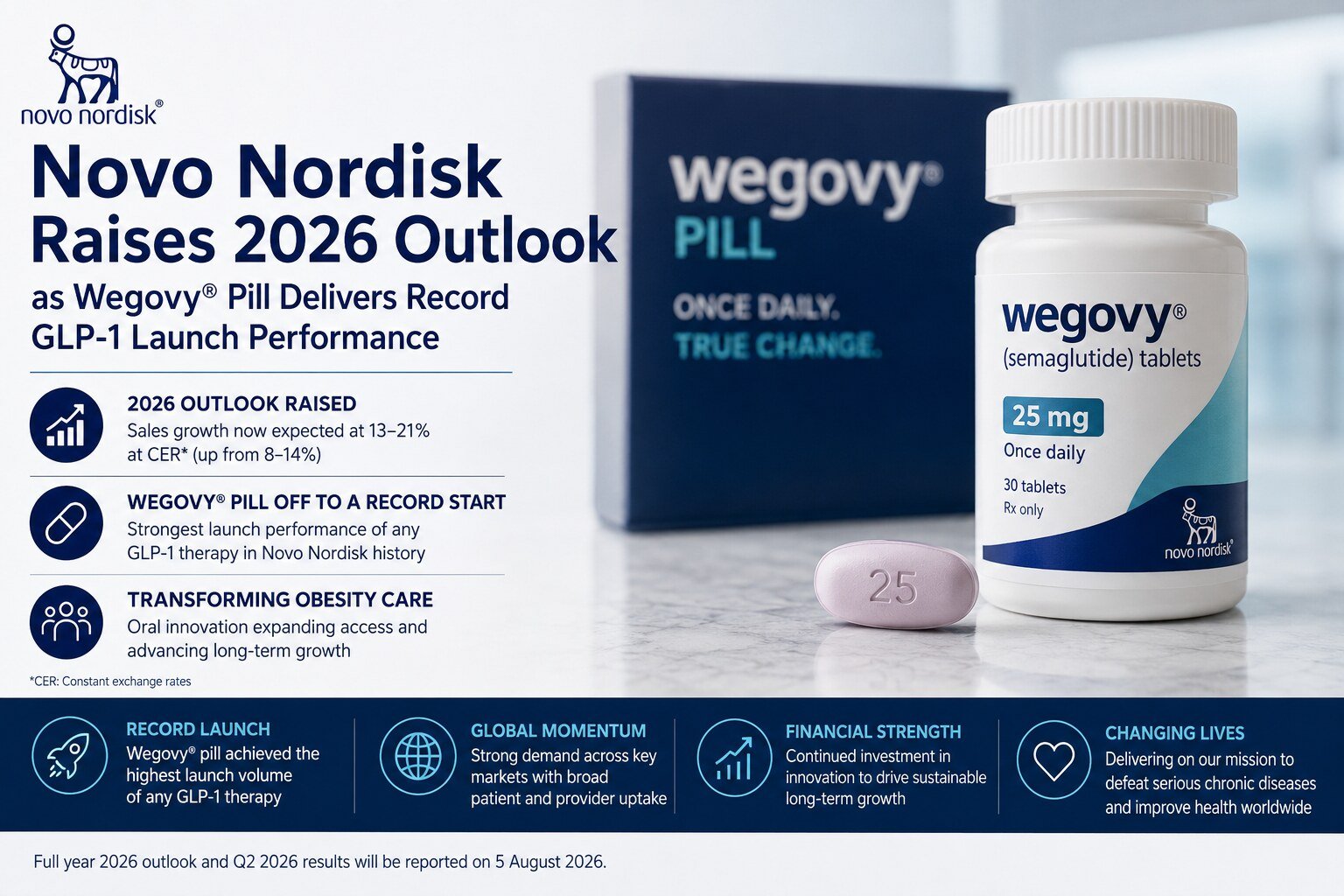
Novo Nordisk reported adjusted operating profit of DKK 33,389 million for the second quarter of 2026 on August 4 and raised its full-year outlook, pointing to faster-than-expected uptake of the Wegovy pill and the newer high-dose Wegovy injection [3][4].
The company now expects adjusted sales growth of 0% to -6% at constant exchange rates for 2026, up from the -4% to -12% range it gave on May 6 [3]. Adjusted operating profit growth carries the same new range [3]. Novo said the improvement is "driven by increased expectations for GLP-1 product sales" [3]. On a non-adjusted basis — meaning before stripping out one-time items — the midpoints of the 2026 guidance would be 5% sales growth and 12% operating profit growth [3].
What the quarter actually showed
Q2 adjusted sales came in at DKK 78,488 million, up 7% at constant exchange rates, driven by GLP-1 volume growth across regions and favorable US rebate adjustments [4][5]. Adjusted operating profit rose 11% [4]. Reported figures looked weaker: reported sales grew 3% and reported operating profit fell 16%, hurt by a comparison to a DKK 2.6 billion rebate reversal tied to the US 340B Drug Pricing Program in Q2 2025 and by DKK 6.3 billion in non-cash impairment charges on pipeline assets, including DKK 4.0 billion for monlunabant [4][5].
The pill numbers are the headline. For the week ending July 17, Wegovy pill total weekly US prescriptions exceeded 265,000, out of roughly 575,000 total weekly Wegovy prescriptions [4][5]. Novo said the oral version has now passed 5 million prescriptions since its January 5 US launch, which it calls a best-in-class GLP-1 volume launch [1][4]. In May, the company had said the pill was used by more than a million patients since January [1].
Sales dollars are still catching up to prescription counts. Wegovy pill brought in DKK 3,218 million in Q2 and DKK 5,474 million in the first half [4][5]. Wegovy injectable remained far larger at DKK 19,484 million in the quarter, but grew only 1% [4][5]. Ozempic, the semaglutide injection for type 2 diabetes, posted DKK 31,375 million, up 5%, while Rybelsus (oral semaglutide for diabetes) fell 4% to DKK 5,228 million [4][5]. Total obesity care sales rose 16% to DKK 23,152 million [5]. Reuters framed the market reaction as skeptical, headlining that the outlook hike "falls flat as Wegovy pill sales fail to impress" [6].
CEO Mike Doustdar said the Wegovy portfolio "remains a key growth driver," citing the pill's US adoption, early uptake abroad, and the rollout of Wegovy HD, the 7.2 mg injectable semaglutide [4][5].
Why it matters for patients
More supply and more competition at the pharmacy counter usually follow this kind of volume growth, but the numbers also show where prices are heading. Novo repeatedly attributed softer sales growth to "lower realised prices" in the US even as volumes climbed [1][5]. In the first quarter, US adjusted sales fell 11% at constant currency for that reason [1]. That pattern — more prescriptions, less revenue per prescription — is the financial signature of cheaper cash-pay and negotiated pricing, though the sources do not break out what individual patients pay.
For people weighing options, the practical takeaway is that oral semaglutide for obesity is now a real, widely dispensed choice in the US rather than a launch-week novelty [4][5]. Novo cites OASIS 4 data showing up to 16.6% mean weight loss for the Wegovy pill and STEP UP data showing up to 20.7% mean weight loss for the 7.2 mg dose [4][5]. Across its products, Novo says it provided medical treatment to 4.9 million people living with obesity in the first half of 2026 [4].
What happens next
Wegovy pill launched in the UAE in June and the UK in July, with more markets planned in coming quarters [4][5]. The EU approved both the Wegovy pill and the 7.2 mg single-dose pen in July, and Novo plans to roll out the 7.2 mg pen across the EU in the second half of 2026 [4][5]. Novo also said its ZEUS phase 3 trial of ziltivekimab, a non-GLP-1 cardiovascular drug, missed its primary endpoint [4].
Whether the raised guidance holds through year-end is not yet known.
Images from the sources
Sources
- https://www.biopharmaboardroom.com/company-results/34/4678/-novo-nordisk-raises-2026-outlook-as-wegovy-pill-delivers-record-glp-1-launch-performance.html
- https://www.novonordisk.com/news-and-media/news-and-ir-materials.html
- https://www.globenewswire.com/news-release/2026/08/04/3338659/0/en/novo-nordisk-raises-adjusted-sales-and-adjusted-operating-profit-outlook-for-2026.html
- https://www.sec.gov/Archives/edgar/data/0000353278/000035327826000023/caq22026.htm
- https://attachment.news.eu.nasdaq.com/a0078e15b379bff5e3b0ffdbddb3d5075
- https://www.reuters.com/legal/litigation/novo-nordisks-q2-profit-beats-forecasts-raises-outlook-2026-08-04
Semaglutides.org is for information only and is not medical advice. Always talk to a licensed healthcare provider about your own care. Some links to telehealth services are affiliate links, labeled where they appear.