Federal price data show prescription drug prices down 3.1 percent year over year, the steepest annual decline since 1963
Federal data show prescription drug prices fell 3.1% over the year ending in July 2026, the biggest drop since 1963, but the index tracks what pharmacies get paid, not what you pay at the counter.
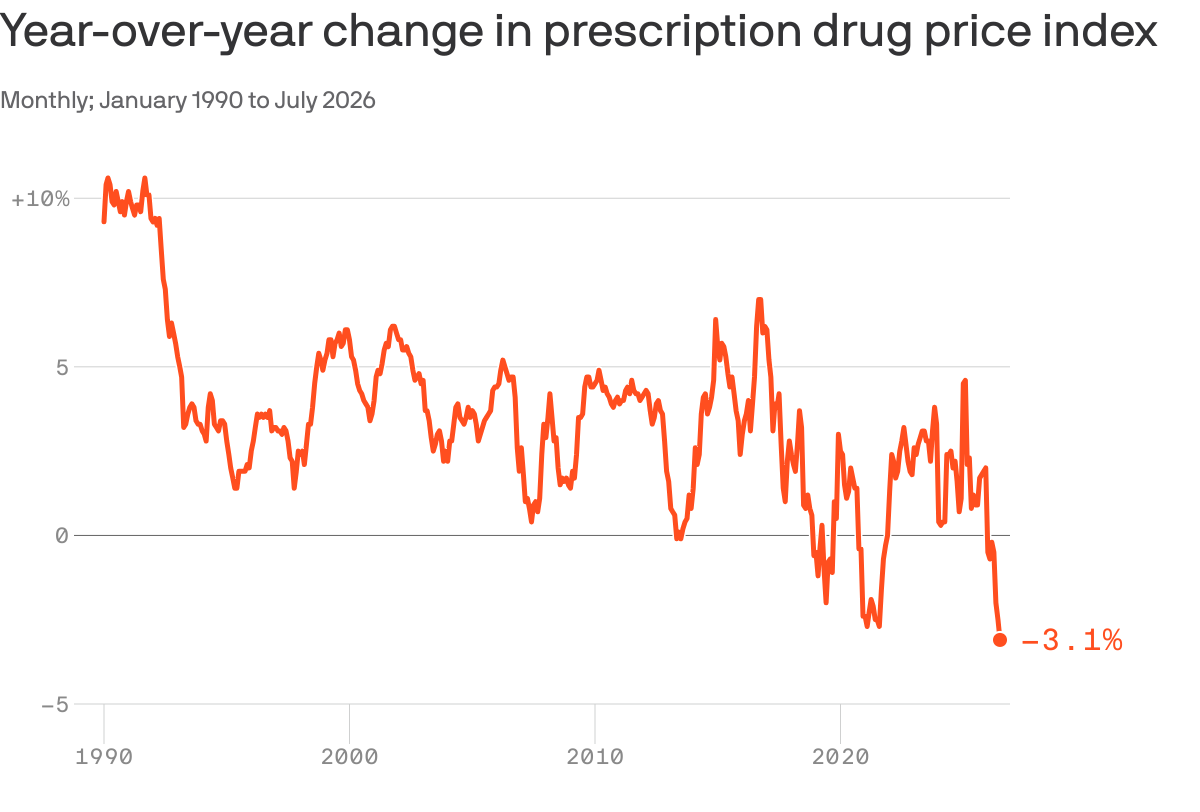
Prescription drug prices in the United States fell 0.8% in July and were down 3.1% from a year earlier, the steepest year-over-year decline since 1963, according to Consumer Price Index data from the Bureau of Labor Statistics [2]. Prices had not risen in any month of 2026 through July, an unusually long stretch of flat or falling drug prices [1].
The decline stands out because other parts of health care are moving the other way. Costs for hospital and physician services have continued to rise even as the drug index falls [1].
What's driving the drop
Drug pricing researchers say no single policy explains it. "It's difficult to know in one number what's going on beneath the hood," said Juliette Cubanski, who directs the Program on Medicare Policy at KFF. "I don't think we can attribute this price reduction to any one specific policy change or initiative" [2].
One widely cited factor is Medicare drug price negotiation, created by the 2022 Inflation Reduction Act. New negotiated prices for the first 10 drugs took effect in January 2026, with prices as much as 79% below their list prices [1]. Cubanski, Harvard Medical School's Dr. Benjamin Rome and Vanderbilt health policy professor Stacie Dusetzina all said that change likely affected aggregate prices [2].
Competition is another force. "When big blockbuster products face generic competition, their prices fall," Rome said, pointing to biosimilars that now compete with Humira; Dusetzina cited similar price cuts for Stelara [2]. In the GLP-1 market specifically, heated competition is pushing down cash-pay prices [1]. Eli Lilly and Novo Nordisk also struck deals with the Trump administration that cut cash prices for GLP-1 drugs and expanded Medicare access [1]. A Trump administration policy lowering GLP-1 prices for certain eligible Medicare enrollees took effect in July, so only its first month shows up in the data [2].
The White House credits its "most favored nation" deals and the TrumpRx website, saying they are "delivering real relief to American families and putting patients first" [2]. Experts said the impact of the MFN deals is unclear because the contracts with drug companies have not been made public and the models for federal health programs have not taken effect. "These policies are under development and have not affected payers in the index," Dusetzina wrote to the Associated Press [2]. USC health economist Geoffrey Joyce said TrumpRx makes discounts easier to find but often points people to prices that already exist: "If you were going to give policy credit, you'd have to say the IRA" [1]. White House spokesperson Kush Desai called that reasoning "idiotic and unfounded" [1]. The White House says TrumpRx has generated $700 million in savings but did not explain how it calculated the figure; Sen. Elizabeth Warren questioned the claim in a letter, noting Health Secretary Robert F. Kennedy Jr. has said the site does not store patient, health or prescription information [2].
Why it matters for patients
The headline number is not a measure of what people pay at the pharmacy counter. The CPI tracks what pharmacies are paid — by insurers and by patients combined — not out-of-pocket spending [2]. Manufacturer rebates paid after a transaction are not captured in the index at all, BLS told Axios [1]. Insurers often absorb much of a drug's cost, and what a patient pays depends on coverage, plan design and whether a cheaper alternative exists [2].
That gap shows up in survey data. Six in 10 Americans told KFF this spring they were worried about affording their medications, the largest share since KFF began asking in 2018, and four in 10 said that in the past year they had not taken a medication as prescribed because of cost [1]. Rising premiums and out-of-pocket costs mean some people may pay more for health care overall even while drug prices fall [2].
"People don't care about what the true cost of the drug is," Joyce said. "They just say, 'What's my copay?' or 'What's my cost sharing at the pharmacy counter?'" [1]
What happens next
Because the Medicare GLP-1 pricing policy started in July 2026, later monthly CPI reports will show more of its effect [2]. The Trump administration has continued the IRA negotiations as required by law and projects additional savings in the years ahead [2]. How much of any of this reaches individual patients is not yet known from these data.
Images from the sources
Sources
Semaglutides.org is for information only and is not medical advice. Always talk to a licensed healthcare provider about your own care. Some links to telehealth services are affiliate links, labeled where they appear.