Status check: the two Medicare prices for semaglutide in 2027 still have not been reconciled
Medicare has two different 2027 prices for semaglutide — about $274 under IRA negotiation and $245 under a most-favored-nation deal — and CMS has not publicly said which one governs.
Two separate government prices for semaglutide are scheduled to be in force in 2027, and the sources available show no public resolution from the Centers for Medicare & Medicaid Services about which one actually governs what Medicare pays.
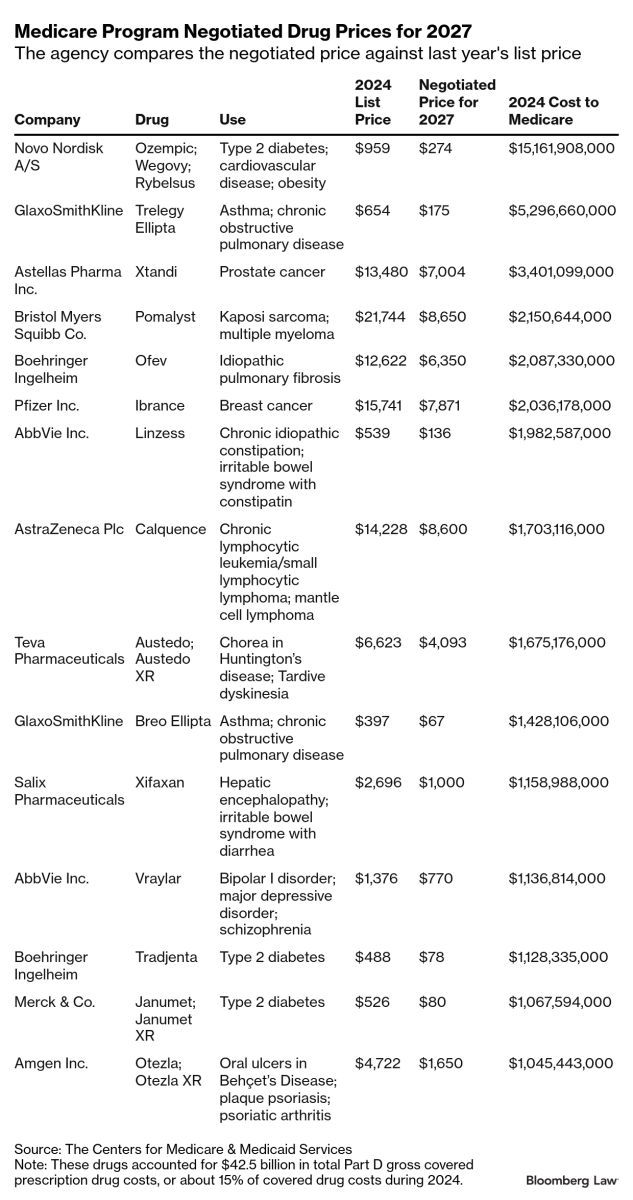
The first price comes from the Medicare Drug Price Negotiation Program created by the Inflation Reduction Act. CMS listed a negotiated "maximum fair price" (MFP) of $274 for a 30-day supply of the Ozempic, Rybelsus and Wegovy group from Novo Nordisk, a 71% discount from the $959 list price used for 2024 fills [1]. Those prices take effect January 1, 2027 [1].
The second price comes from the Trump administration's "most-favored-nation" (MFN) agreement with Novo Nordisk, which set a $245 monthly Medicare price for Ozempic and Wegovy and was scheduled to launch in 2026 [2]. That deal ties US prices to international ones. Because both are slated to be in effect in 2027, the overlap has not been sorted out publicly [2].
The $274 figure is an average, not the price on your pen
CMS's own file shows the MFP differs by dosage form and strength. For a 4 mg/3 mL Ozempic pen, the MFP per package is $276.78. For 30 tablets of Rybelsus 7 mg, it is also $276.78. For four Wegovy pens at 2.4 mg/0.75 mL — the highest maintenance dose — it is $385.63 [1]. So the widely quoted "$274" is a summary figure for a 30-day supply, while the actual per-package prices run from roughly $276 to about $385 [1][2].
The scale here is large. In 2024, about 2.28 million Medicare Part D enrollees used drugs in the Ozempic/Rybelsus/Wegovy group, which accounted for $15.16 billion in Part D gross covered prescription drug costs — the biggest of the 15 drugs in this negotiation round [1]. Across all 15 drugs, 5.3 million of 53 million Part D enrollees used them, totaling $42.5 billion, and CMS estimated the negotiated prices would have saved about $12 billion, or roughly 44% of net spending, had they applied in 2024 [1].
Why the two prices may not simply merge
Experts quoted by Bloomberg Law described a structural difference between the two. "There is no requirement that the MFN price is necessarily picked up by payers," said Brian Reid of Reid Strategic. "Whereas the MFP price will be required — that has to be on the formulary" [2]. Sarah Emond, CEO of the Institute for Clinical and Economic Review, said that because Novo isn't bound to offer the MFN price, the $245 figure "may not stand" since the negotiated price is higher [2].
Novo Nordisk framed the two as covering different ground: a spokesperson said the MFP "is a mandatory price-setting process established under the Inflation Reduction Act and for semaglutide applies specifically to Medicare Part D," while the MFN agreement "reflects a broader effort to expand access to obesity care across Medicare and Medicaid," adding the company looks "forward to additional clarity from CMS" [2]. The consulting firm Capstone wrote that it is "unclear how the two proposals will interact and which would be the 'real' price when both MFN and MFP are effective in 2027" [2].
Why it matters for patients
What a Medicare enrollee actually pays at the pharmacy counter depends on plan design, not just the government's benchmark price — and right now two benchmarks exist. Kristi Martin, a former Medicare chief of staff, said there is "a lot of missing information" about what this means for Part D insurers and how it will affect premiums [2].
There is also a separate, unresolved coverage question. Medicare's rules on covering drugs for obesity were not adopted by CMS in April [2]. Rachel Sachs of WashU Law suggested the administration could use another vehicle, such as a Center for Medicare and Medicaid Innovation demonstration [2]. Until that is settled, a lower negotiated price for Wegovy does not automatically mean Part D coverage for weight management.
What happens next
The negotiation period ended November 1, 2025, and the MFPs take effect January 1, 2027 [1]. The MFN prices were scheduled to launch in 2026 [2]. Whether CMS issues guidance reconciling the two — and when — is not stated in the available sources.
Sources
Semaglutides.org is for information only and is not medical advice. Always talk to a licensed healthcare provider about your own care. Some links to telehealth services are affiliate links, labeled where they appear.