Novo Nordisk's daily Wegovy pill reaches patients as Eli Lilly's oral GLP-1 nears approval
Daily GLP-1 pills are reaching U.S. patients, removing refrigeration and needle disposal, though they are not expected to produce more weight loss than weekly shots.
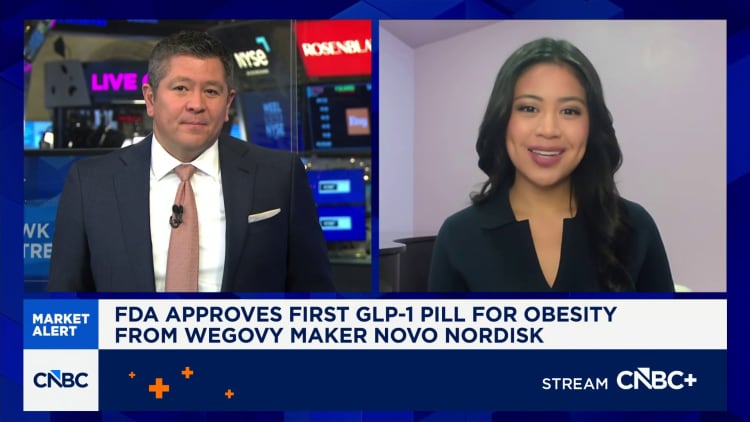
The first once-daily GLP-1 pill for obesity is now reaching patients in the United States, and a rival oral drug from Eli Lilly is expected to win U.S. approval within months, opening a new phase for a market built on weekly injections [2].
Novo Nordisk's pill shares the Wegovy brand name with the company's injectable and is taken once a day. Cash prices run from $149 to $299 a month depending on dose, slightly below the newly lowered cash prices of the injections, and Eli Lilly's oral drug is expected to carry similar cash pricing [2]. Under an agreement both companies struck with the Trump administration in November, cash-paying patients can get the starting dose of either pill for $149 a month through the TrumpRx direct-to-consumer site [2].
A different set of logistics
Moving from a weekly shot to a daily pill also removes two features of injection treatment: refrigeration and needle disposal. Deborah, a 53-year-old librarian in St. Louis who has been taking weekly Wegovy injections since June, said a pill would make travel easier because it would not need to be kept cold [2]. How much waste or how many emissions the single-use injector pens and the cold-chain shipping that moves them generate has not been disclosed.
Pills are not expected to produce more weight loss than weekly shots, based on separate clinical trials. Zepbound (tirzepatide) has shown average weight loss of more than 20% in late-stage studies, higher than the Wegovy injection, the Wegovy pill and Eli Lilly's oral drug in their own trials [2]. In those studies, about 7% of patients or fewer stopped treatment because of side effects with the Zepbound and Wegovy injections. The Wegovy pill showed similar discontinuation rates, while about 10.3% of patients taking the highest dose of Eli Lilly's oral drug stopped because of side effects [2].
Eli Lilly's pill, orforglipron, is a small-molecule drug that is absorbed more easily and does not require the dietary restrictions that come with Novo Nordisk's peptide pill, which patients are supposed to take with no more than four ounces of water before waiting 30 minutes to eat or drink anything else [2].
Costs and coverage
Patients with insurance coverage for Novo Nordisk's oral drug can pay as little as $25 a month [2]. Injections have long listed at roughly $1,000 a month, and both companies have cut cash prices: Novo Nordisk said in November that nearly all doses of Wegovy would cost $349 a month in cash, and Eli Lilly said in December that the highest doses of single-dose Zepbound vials would cost $449 a month [2].
About 1 in 8 U.S. adults said they were taking a GLP-1 drug to lose weight or treat another chronic condition as of November, according to a KFF poll [2]. Goldman Sachs analysts forecast in August that pills could capture roughly 24% — about $22 billion — of the global weight-loss drug market by 2030 [2].
Why it matters for patients
For people who pay out of pocket, the pill's highest doses cost about $150 a month less than the highest-dose Zepbound vials, a gap that Dr. Eduardo Grunvald of UC San Diego Health called "a big difference for many people" [2]. But cost is also the main reason a patient doing well on an injection might switch. Dr. Caroline Apovian of Brigham and Women's Hospital said that if cash prices are similar, she prefers injectables because she believes weight loss is better and side effects are less, and that she wants real-world data comparing the two [2].
Even with a lower cash price, coverage remains uncertain. John Crable of the benefits brokerage Corporate Synergies said some employers have dropped GLP-1 coverage for obesity in 2026 because of cost, and that he does not see employers being highly motivated to add another high-cost drug to their formularies [2].
Convenience cuts both ways. Karen Galante, 42, of Horsham, Pennsylvania, who takes a compounded version of semaglutide, said she does not plan to switch. "It's hard enough for me to remember to take my vitamins every day," she said. "I like the set-it-and-forget-it of taking one shot a week" [2].
What happens next
Eli Lilly's orforglipron was described in January as months away from the U.S. market, with approval expected later in 2026; a specific date has not been disclosed [2]. Leerink Partners analyst David Risinger said he expects Novo Nordisk's pill to gain ground first because Eli Lilly's drug is not yet available, but that Eli Lilly's pill could ultimately generate higher sales if patients find it more convenient [2].
Images from the sources
Sources
Semaglutides.org provides information only, not medical advice. Talk to a licensed provider about your own care before making changes. Some telehealth links are affiliate links and are labeled where they appear.