CMS shelves Medicare Part D launch of BALANCE for 2027 and extends GLP-1 Bridge
Medicare Part D plans will not offer BALANCE model GLP-1 coverage in 2027, but the temporary Bridge program now runs through the end of 2027 at $50 a month.
CMS will not launch the Medicare Part D portion of the BALANCE model in 2027, announcing the change on April 21, 2026 — one day after Part D plan sponsor applications were due — and extending a separate short-term demonstration, the Medicare GLP-1 Bridge, through December 31, 2027 [1][4].
BALANCE was designed to test expanded Part D coverage of GLP-1 medications for weight management from January 1, 2027 through December 31, 2031 [1][2]. CMS accepted Part D sponsor applications until April 20, 2026, and had said it would tell plans by April 30, 2026 whether it would move forward [2]. The model was conditioned on participation by a critical mass of sponsors [2]. One coverage guide describes the test as sponsors covering at least 80% of all Part D beneficiaries [4], while an industry briefing describes it as 80% of Part D sponsors [3].
CMS describes the Part D launch as indefinitely delayed rather than canceled [1]. The memo sent to plan sponsors framed the decision as "pending further evaluation and data collection" [4]. A coverage guide says the next signal to watch is the CY2028 Advance Notice, typically released in January or February 2027 [4]. No 2028 launch date has been confirmed.
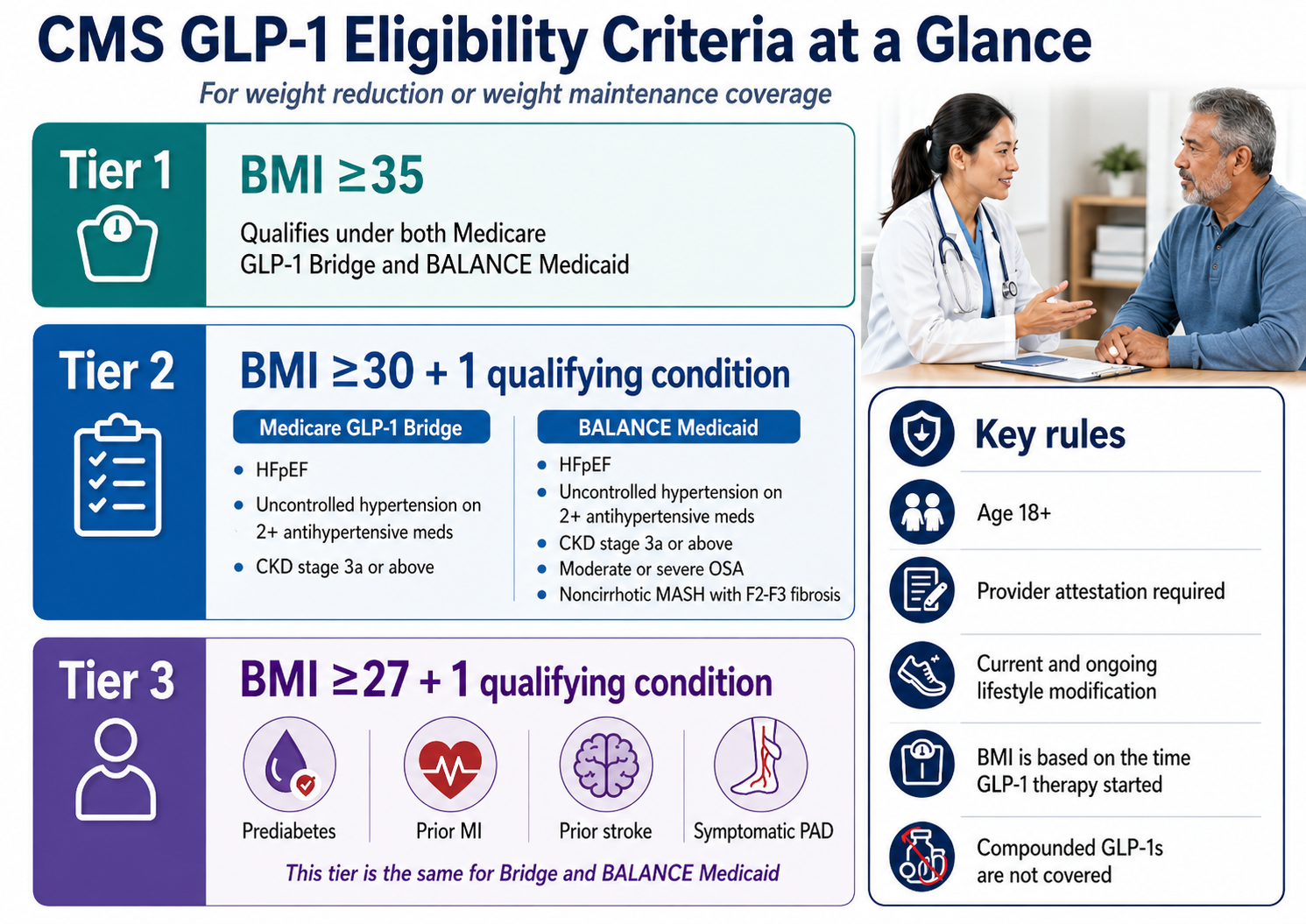
The Medicare GLP-1 Bridge, originally scheduled to run from July through December 2026, will now run from July 1, 2026 through December 31, 2027 [1][4]. It operates outside regular Part D coverage, is nationwide, and does not require plans to opt in [1]. Beneficiaries who qualify pay $50 per month for GLP-1s approved for weight reduction: all formulations of Foundayo (orforglipron) and Wegovy (semaglutide), plus the KwikPen formulation of Zepbound (tirzepatide) [1]. Eligibility generally follows BMI: 35 or higher; 30 or higher with heart failure with preserved ejection fraction, uncontrolled hypertension, or chronic kidney disease stage 3a or above; or 27 or higher with prediabetes, a prior heart attack, a prior stroke, or symptomatic peripheral artery disease, with provider attestation [1][4].
The Medicaid side of BALANCE was not affected [1][4]. State Medicaid agencies can apply until July 31, 2026 and start on a rolling basis between May 1, 2026 and January 1, 2027, with the model running through December 31, 2031 [1][4]. Only 13 states covered GLP-1s for obesity in Medicaid as of January 2026, down from 16 in 2025 [1][3].
On why the Medicare piece stalled, a coverage guide reports that UnitedHealthcare said publicly it was "still working through" whether to participate, and that Bloomberg reporting indicated CVS Health (Aetna) declined [4]. Those decisions are described as leaving the 80% threshold out of reach [4]. A separate industry briefing, published before the announcement, said most Part D sponsors did not expect the threshold to be met [3].
BALANCE's Medicare design would have set cost sharing at $50 a month in enhanced plans and $125 a month in basic plans, with a negotiated net price of $245 per 30-day supply from Novo Nordisk and Eli Lilly for 2027 [3].
Why it matters for patients
Medicare Part D enrollees who want a GLP-1 for weight reduction still have a route in 2027, but only through the Bridge, which covers specific formulations and ends December 31, 2027 unless it is extended again [1][4]. People who take these drugs for type 2 diabetes, cardiovascular risk reduction, or sleep apnea use regular Part D coverage rather than the Bridge or BALANCE [1][4].
For Medicaid, access depends on whether a state joins. Participation is voluntary, and KFF notes states may join for one year and drop out, which could disrupt coverage [3]. For 2027 plan comparisons, BALANCE participation is no longer a difference between plans, since no Part D portion is launching that year [4].
Cost pressure remains the backdrop. In KFF polling, 56% of GLP-1 users said the drugs were difficult to afford, including one in four who said "very difficult" [1]. In 2024, Medicare recorded 21.8 million GLP-1 claims and $27.5 billion in gross spending, and Medicaid recorded 8.4 million prescriptions and $8.6 billion, before rebates [1]. CMS documentation does not include estimates of the Bridge's or BALANCE's effects on federal or state budgets [3], and KFF wrote there is "little evidence to date" that expanded GLP-1 use is offset by lower spending on other health services in the short term [3].
What happens next
- May 1, 2026 to January 1, 2027: BALANCE launches for state Medicaid agencies on a rolling basis [1].
- July 1, 2026: Medicare GLP-1 Bridge coverage begins [1].
- July 31, 2026: Deadline for state Medicaid agencies to apply to BALANCE [1].
- January or February 2027 (expected): CY2028 Advance Notice, described as the next signal on Medicare BALANCE [4].
- 2027: The negotiated Medicare price for semaglutide (Ozempic, Wegovy, Rybelsus) takes effect [1].
- December 31, 2027: The Medicare GLP-1 Bridge ends as currently scheduled [1][4].
Images from the sources
Sources
- https://www.kff.org/medicare/what-to-know-about-the-balance-model-for-glp-1s-in-medicare-and-medicaid
- https://www.cms.gov/priorities/innovation/files/balance-part-d-plans-rfa.pdf
- https://www.advisory.com/daily-briefing/2026/04/15/balance-model-oi-ec
- https://therxindex.com/guides/cms-balance-model-glp-1-coverage-criteria/
- https://www.kff.org/medicare/what-to-know-about-the-balance-model-for-glp-1s-in-medicare-and-medicaid/
Semaglutides.org provides information only, not medical advice. Talk to a licensed provider about your own care before making changes. Some telehealth links are affiliate links and are labeled where they appear.