Medicaid GLP-1 discount program deadline passes with no participating state named
States had until July 31, 2026 to join a federal program that would cover GLP-1 obesity drugs for Medicaid enrollees at negotiated prices, and none has been named. Coverage still depends on where a patient lives.

The deadline for state Medicaid agencies to apply to a federal program that would let them cover GLP-1 obesity drugs at negotiated prices passed on July 31, 2026, and no participating state has been named [1][2]. In mid-August 2026, the Centers for Medicare & Medicaid Services (CMS) BALANCE Model page still listed the number of participants as not applicable [2].
The BALANCE Model, short for Better Approaches to Lifestyle and Nutrition for Comprehensive hEalth, lets CMS negotiate drug prices with manufacturers on behalf of state Medicaid agencies and Medicare Part D plans. Participation is voluntary for drugmakers, states and plans [2].
For Medicaid, the model began in May 2026 and states could launch on a rolling basis through January 1, 2027. It is scheduled to run through December 31, 2031 [1]. Manufacturers faced a January 8, 2026 application deadline, and CMS and manufacturers had a pre-implementation period from January 12 to February 5, 2026 to set the terms of participation agreements [1]. The April 20, 2026 deadline for Medicare Part D sponsors to apply also passed [1].
On April 21, 2026, CMS announced an indefinite delay of the BALANCE Model in Medicare Part D and an extension of a separate program, the Medicare GLP-1 Bridge [1]. The Bridge now runs from July 1, 2026 through December 31, 2027, originally scheduled to end in December 2026. It covers all formulations of orforglipron (Foundayo) and semaglutide (Wegovy) and the KwikPen form of tirzepatide (Zepbound) at a $50 monthly copayment [1]. It is a nationwide demonstration separate from Part D, so Part D sponsors do not opt in and carry no financial risk for it [1].
Beneficiaries need a prior authorization request from their provider attesting the drug is prescribed to reduce excess body weight and maintain weight reduction. They must also meet one of three criteria: a BMI of 35 or higher; a BMI of 30 or higher with heart failure with preserved ejection fraction, uncontrolled hypertension, or chronic kidney disease stage 3a or above; or a BMI of 27 or higher with prediabetes, a previous heart attack, a previous stroke or symptomatic peripheral artery disease. Model beneficiaries receiving a drug for the weight management indication must be 18 or older [1].
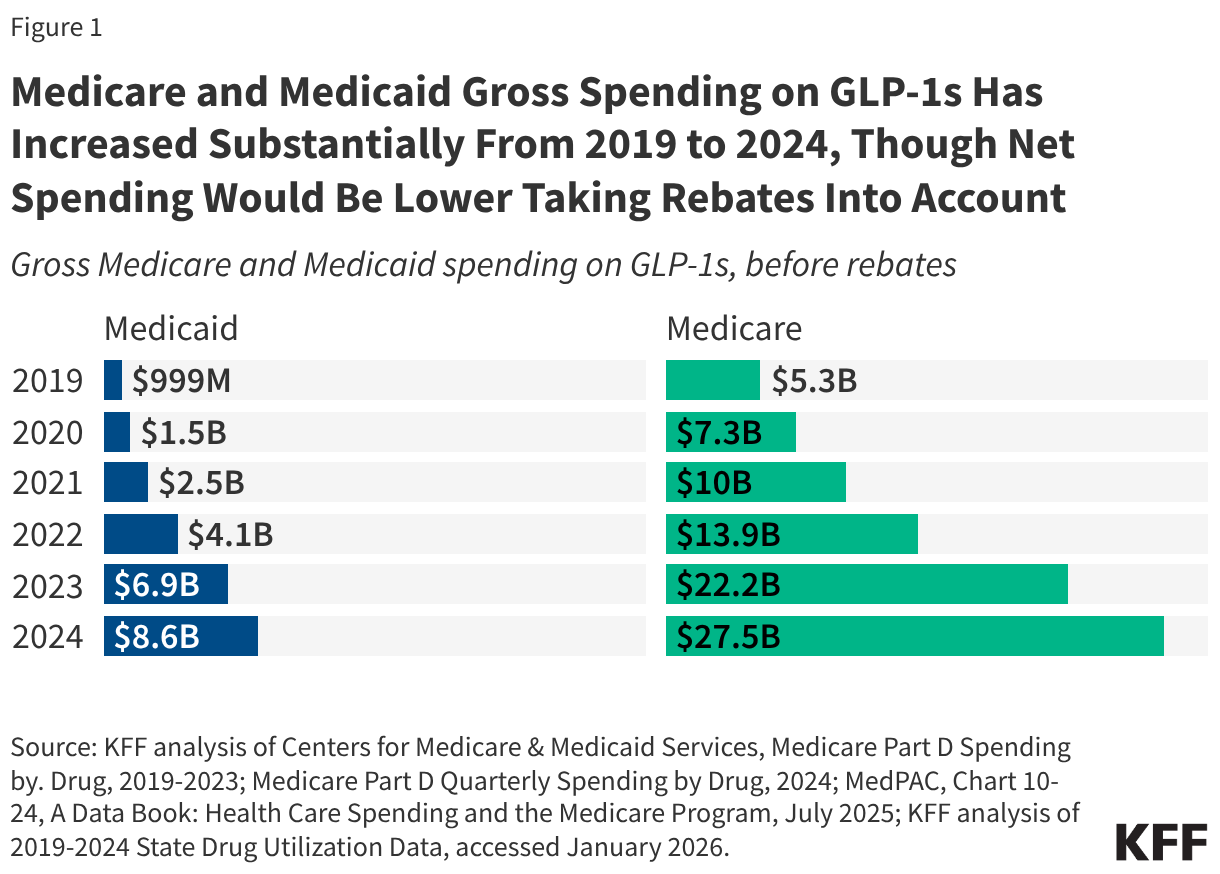
Medicaid coverage has been tightening. Only 13 states covered GLP-1s for obesity as of January 2026, down from 16 in 2025 [1]. Federal law requires state Medicaid programs to cover GLP-1s for medically accepted indications such as type 2 diabetes but leaves weight-loss coverage optional [1]. In 2024, Medicaid recorded 8.4 million GLP-1 prescriptions and $8.6 billion in gross spending, and Medicare recorded 21.8 million claims and $27.5 billion in gross spending, not counting rebates [1]. In KFF polling, 56% of GLP-1 users said the drugs were difficult to afford, including one in four who said they were very difficult to afford [1].
Why it matters for patients
Whether a Medicaid enrollee can get a GLP-1 for obesity still depends on the state they live in. If their state did not apply to the BALANCE Model, or applied and has not been announced, the deadline's passing changes nothing about what Medicaid covers in that state. Which states applied, how many, and whether CMS will reopen the application window have not been disclosed.
The Medicare GLP-1 Bridge is different: it is nationwide, so people with Part D coverage who meet the clinical criteria can get the covered drugs for $50 a month even if their plan did not sign up for anything [1]. The prior authorization step is still required [1].
What happens next
States that joined the Medicaid BALANCE Model can implement on a rolling basis through January 1, 2027 [1]. The model ends for state Medicaid agencies on December 31, 2031 [1]. Medicare beneficiaries keep access to obesity drugs through the GLP-1 Bridge until December 31, 2027 [1]. The BALANCE Model in Medicare Part D remains indefinitely delayed with no new start date announced [1]. Separately, semaglutide (Ozempic, Wegovy, Rybelsus) was selected in 2025 for Medicare drug price negotiation, with a negotiated price set to take effect in 2027 [1].
Images from the sources
Sources
Semaglutides.org provides information only, not medical advice. Talk to a licensed provider about your own care before making changes. Some telehealth links are affiliate links and are labeled where they appear.